Getting started
How to set up a home boxing space in a garage or apartment
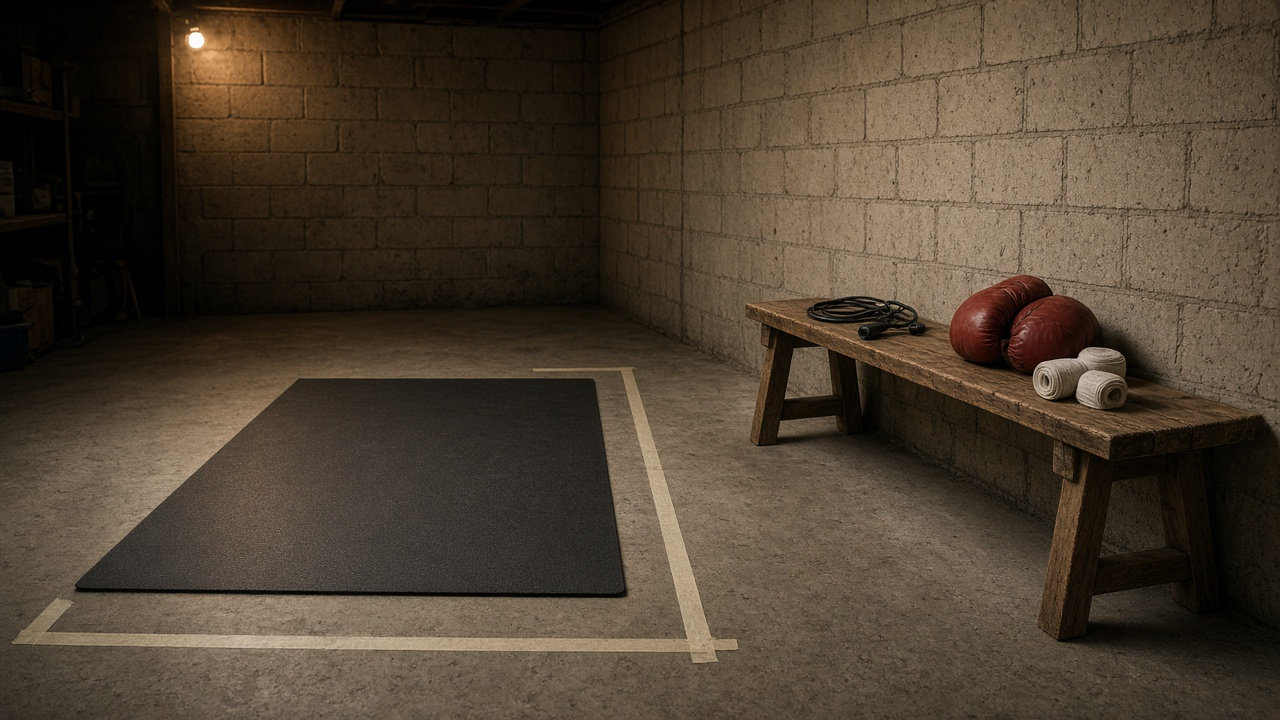
You do not need a ring or a full gym to start bag work at home. You do need a clear, stable place to stand, and — if you use a bag — enough room to set it up the way its manual describes. This page collects published clearance figures from Everlast manuals, plus the floor and neighbor issues the starting-kit guide already flags, and applies them to a garage stall or an apartment corner. It is not a floor plan, a class, or a promise that your room is big enough.
This is not medical advice and not a product review. The area, ceiling, and fill figures below belong to the specific Everlast models named in the sources. A different bag or stand can need a different space. Follow the manual that comes with your equipment. This site will not invent a joist rating, a floor-load limit, or a decibel number. Consult a physician before a new exercise program, as Everlast’s own bag-stand and freestanding-bag manuals require. USA Boxing requires that sparring be supervised by a certified coach; this site does not recommend sparring at home.
Some links on this page go to example products on Amazon. As an Amazon Associate I earn from qualifying purchases. These are examples, not reviews, and they are not a claim that any product is best. Check the seller’s current size, weight, and return policy before you buy.
Measure the room against a manual, not a guess
Before you buy a bag or drill a hole, measure ceiling height, the clear floor, and the walking paths through the room. Then read the manual for the exact model you are considering. Two Everlast documents already used on this site give a concrete minimum for those products: both the 4813 Heavy Bag/Speed Bag Stand manual and the 2228 Powercore Freestanding Heavy Bag Owner’s Manual recommend a spacious area of at least 4 feet by 6 feet, free of surrounding objects, for assembly and use. The 4813 manual also asks for a ceiling at least 7 feet 3 inches high. Those numbers are for those units. They are not a universal “home gym” size, and this page will not invent a larger one. The 4813 stand is sold as the Everlast 2-Station Heavy Bag Stand (model 4813BDTC). A current filled-base example is an Everlast Powercore freestanding heavy bag — confirm the model and fill weights on the listing against the 2228 manual quoted here, which may describe a specific older unit.
If you plan to hang a bag, ceiling height is the bag length plus the hanger, swivel, and any chain the hang sheet specifies — not the stand figure above. Use the hang instructions for that hardware. For model-specific warnings, see the mounting and stand safety guide. For which bag system fits a rental at all, see heavy bag vs freestanding bag for apartments.
Leave a path, not just a footprint
The bag has to fit, and you have to be able to step around it. Everlast’s punching-bag guide describes working around a freestanding bag to improve footwork. Everlast’s wood-beam hanger instructions go further on placement: stay at least 5 feet from any doorway or obstruction, and do not put that hanger where people may pass by and get “bumped.” That five-foot figure belongs to that hanger, but the idea is practical in a hallway, kitchen, or garage bay you also walk through. If the only open corner blocks a door, a water heater, or a parked car’s path, it is not a training space.
Floor, sliding, and what a mat can and cannot do
Use a stable, level, non-slip surface. The Powercore manual says that bag can slide or shift depending on the surface it rests on, and it suggests a non-slip surface to reduce that. That is a sliding warning, not a sound-isolation claim, and not a specification for how thick a mat should be. This site will not invent a mat thickness, a foam density, or a reduction in noise.
A hanging bag still needs a structure that can take a swinging load; a filled-base bag still needs a floor that can take the filled base. Everlast lists the Powercore base at approximately 250 pounds with water or 370 pounds with sand, and it recommends sand for best performance. We will not turn those fill weights into a rating for your slab, joists, or upstairs apartment floor. If you are not sure, stop and check with a qualified person or, in a rental, the landlord.
Neighbors, garages, and outdoor-looking spaces
A bag will make noise. The starting-kit guide already treats that as a household issue, not a spec we can invent. If people share a wall, a ceiling, or a floor with you, talk with them before you commit to a heavy setup. We have no manufacturer decibel rating to cite.
A garage can be a good indoor room, or it can be a poor one: low clearance, a sloping or damp floor, a walkway you still need, or a door you want to leave open onto a driveway. Everlast’s 4813 stand page and the Powercore product page both say those products are not recommended for outdoor use. Do not treat a balcony, a patio, or an open driveway as an indoor setup those manuals allow.
Everlast also says the Powercore is not a toy and that children should not use it without adult supervision, and its hang sheet says to keep heavy bags away from children and to inspect the equipment before each use. Build the space so the bag is not in a play area or a passageway.
If the bag will not fit — or is not up yet
You can start without a bag. Shadowboxing needs room to stand and step, not a mount. A jump rope needs overhead clearance and a floor you will not wreck; it is useful, and not required for a first bag session. The free home workouts include short shadowboxing and rope sessions you can do in a clear corner.
Once you do have gloves and wraps, give them air after training rather than sealing them in a bag. The glove-care guide follows Everlast’s wipe-and-air-dry routine. Keep the kit on a bench or hook in the same corner so the floor stays clear to step. Then learn a stance and the two straight punches in the air, and use the beginner session guide when the bag is actually set up safely.
Sources
- 4813 Heavy Bag/Speed Bag Stand Owner’s Manual — Everlast. Area of at least 4 ft × 6 ft and a ceiling at least 7 ft 3 in for assembly and use of that stand; physician consult and other safety warnings. Linked from Everlast Canada’s product-manuals page.
- Heavy Bag Stand — Everlast. Not recommended for outdoor use; accommodates a heavy bag up to 100 pounds.
- Everlast 2228 Powercore Freestanding Heavy Bag Owner’s Manual. Area of at least 4 ft × 6 ft, free of surrounding objects; non-slip surface because the bag can slide or shift; sand recommended for best performance; inspect and tighten bolts before each use; physician consult; not a toy; adult supervision for children.
- Powercore Freestanding Heavy Bag — Everlast. Approximate base fill of 250 lb of water or 370 lb of sand; not recommended for outside use.
- Everlast Wood Beam Heavy Bag Hanger instructions, AD07515-4680IS-0722. Stay at least 5 feet from any doorway or obstruction; avoid a location where people may pass by and get bumped.
- How To Choose A Boxing Or Martial Arts Punching Bag — Everlast. Working around a freestanding bag; freestanding bags as quick to set up and take down.
- Everlast Heavy Bag Instructions, AD07515-R2-0626. Inspect equipment before each use; keep it away from children; Everlast heavy bags are not for outdoor use.