Talk with a doctor first
If you are new to exercise, returning from an injury, or have a health condition, talk with a doctor or other clinician before you start. Grappling can be vigorous, and it includes close contact and work on the ground.
Free beginner guide
What BJJ is, how to walk into a first class with less confusion, what gear you actually need, and a free 4-week starter PDF you can download with no email signup.
Download the free starter guideThis section is published by Home Corner Boxing as a free beginner resource. It is not a gym, not a class schedule, and not a list of instructors. Nothing here is medical advice, and nothing here is a substitute for learning with a qualified coach on a mat.
Brazilian jiu-jitsu is a grappling martial art. Instead of punching or kicking as the main work, people train how to control a partner on the ground, improve their position, and — in class, under a coach — practice submissions such as joint locks and chokes. Training is usually done on mats, either in a gi (the jacket and pants uniform) or in no-gi clothes such as a rash guard and shorts.
Schools differ in how they teach, how much they emphasize sport competition, and how they run a class. This page describes common beginner patterns, not the rules of one academy.
If you are new to exercise, returning from an injury, or have a health condition, talk with a doctor or other clinician before you start. Grappling can be vigorous, and it includes close contact and work on the ground.
Practice submissions, sparring, and “rolling” only under a qualified coach in a proper class. Do not invent submissions at home with a friend, and do not try to “see if it works” on someone who is not training with you.
Tapping — a tap on your partner, or a clear verbal “tap” — is how you end a technique. Tap early if something feels sharp, scary, or stuck. If your partner taps, release right away. That is the agreement that keeps people coming back.
Mention injuries, limited mobility, or if this is your very first class. You can also ask whether a trial class is appropriate and what to wear. You do not have to be fit or coordinated before you show up.
Exact class shape varies, but a first visit often includes some of the following. Treat this as a sketch, not a promise about any particular school:
You do not need to “win” your first class. The useful outcome is leaving with a clearer picture of how that school teaches, and without an injury.
You usually do not need to buy a full kit before you visit. Many schools will tell you what to wear for a first class, and some will loan a gi. Ask them. This list is only a plain-language overview — there are no product links or prices here, and this is not a review of brands.
A gi is a sturdy jacket and pants, often worn with a belt the school will typically provide or sell once you join. Look for a fit you can move in, with no sharp buttons or rings. The school may have a color or patch rule; ask before you buy.
A fitted rash guard and shorts or spats that stay in place, without zippers, belt loops, or pockets that can catch fingers. A regular T-shirt often rides up; a rash guard usually stays put.
A mouthguard is commonly recommended. Some people use thin grappling-style ear protection. Shoes come off before you step on the mat. Wait to buy extras until you know how often you will train and what that school prefers.
A printable PDF with solo drills (shrimping, bridging, and the technical stand-up), the core positions, basic escape ideas to learn with a coach, hygiene and etiquette, a week-by-week checklist, and a safety reminder. No email gate.
Download the BJJ Beginner Starter Guide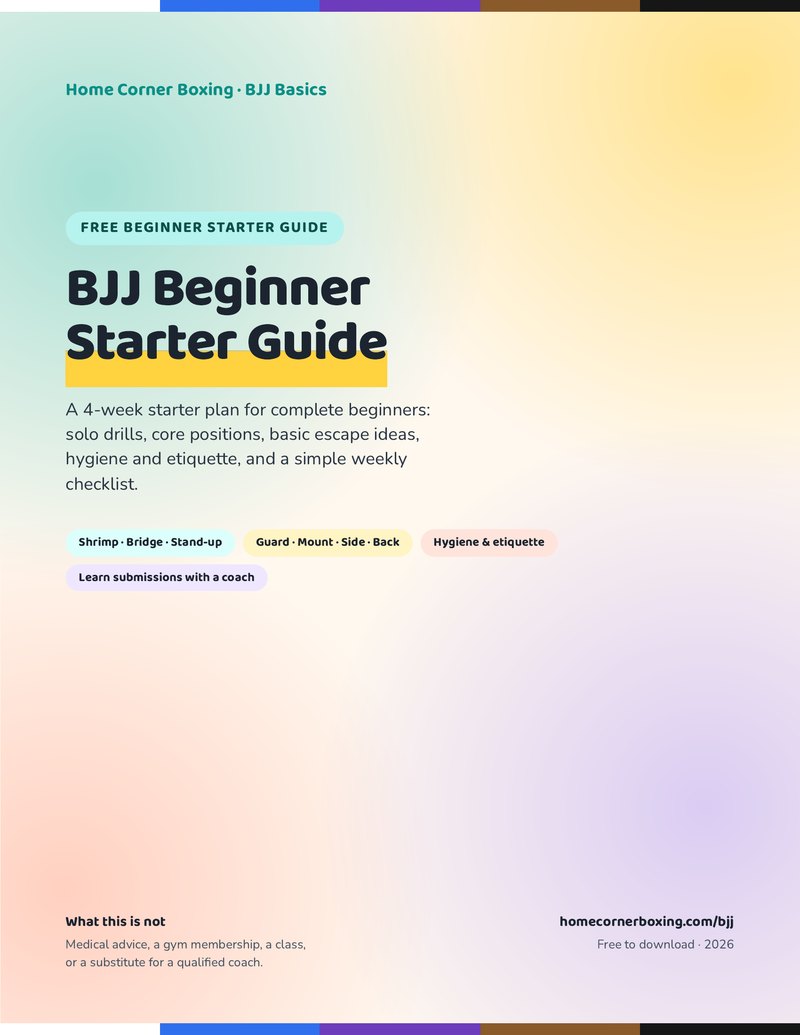
Talk with a doctor or other clinician before you start if you are new to exercise, returning from an injury, or have a health condition. Learn submissions only under a qualified coach. Tap early, and release immediately when your partner taps. Stop if you feel sharp pain, dizziness, or unusual shortness of breath. This page and the PDF are educational, not a class, not a ranking, and not medical or coaching advice.
This beginner BJJ section is part of Home Corner Boxing. For home boxing guides and free bag-work PDFs, start on the boxing homepage or the free downloads page.